What Are Colored Contacts?
Colored contacts are contact lenses designed to change, enhance, or completely transform the appearance of the iris while optionally correcting vision.
Unlike clear contact lenses, colored contacts contain carefully engineered pigment patterns that modify the visible eye color without blocking the pupil. The colored portion sits over the iris, while the center remains transparent so light can enter the eye normally.
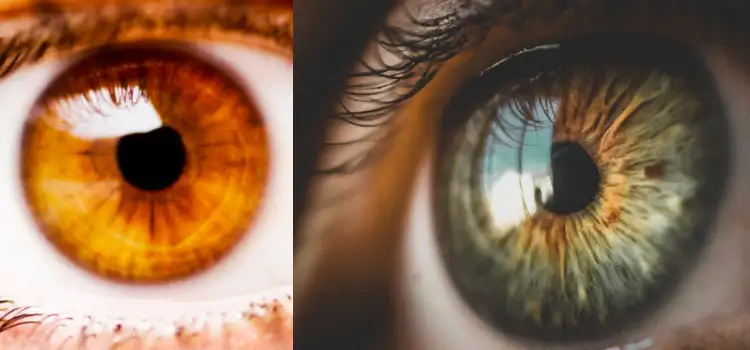
Colored contacts serve two primary functions:
- Cosmetic enhancement
- Vision correction
Some people wear colored contacts to subtly brighten their natural eye color. Others use them to create dramatic transformations for beauty, fashion, cosplay, film production, photography, or special events.
Prescription colored contacts combine cosmetic benefits with vision correction and may correct the following:
- Myopia (nearsightedness)
- Hyperopia (farsightedness)
- Astigmatism
- Presbyopia
A common misconception is that cosmetic colored contacts are beauty accessories rather than medical devices. In reality, the eye cannot distinguish between a prescription lens and a cosmetic lens. Both rest directly on living tissue.
For this reason, the U.S. Food and Drug Administration classifies all contact lenses as medical devices regardless of corrective power.
How Colored Contacts Work
Colored contacts work by altering the visible appearance of the iris rather than changing the iris itself.
The iris contains melanin, the pigment responsible for eye color. Individuals with dark brown eyes generally have higher melanin concentrations than those with blue, green, or gray eyes.
This difference explains why the same lens can produce dramatically different results on different people.
For example:
- A blue enhancement tint may appear vibrant on naturally blue eyes.
- The same lens may show little change on dark brown eyes.
The effectiveness of a colored contact lens depends on the following:
- Natural eye color
- Iris pigmentation
- Pigment opacity
- Lens design
- Lighting conditions
- Pupil size
Professional lens designers often focus more on iris simulation than color itself.
Natural irises contain:
- Radial fibers
- Furrows
- Crypts
- Collarette structures
- Multiple pigment layers
Premium colored contacts attempt to replicate these structures using sophisticated printing and pigment technologies.
This is one reason high-quality lenses appear natural while lower-quality lenses often look artificial.
Why Some Colored Contacts Look Natural While Others Look Fake
Many consumers assume realism depends entirely on lens color.
In reality, realism depends on anatomy replication.
A natural iris is not a single color. It contains multiple shades, textures, and gradients that interact with light differently across the eye.
Low-quality lenses often create a flat layer of color.
High-quality lenses incorporate the following:
- Multi-tone pigmentation
- Radial iris patterns
- Limbal rings
- Color gradients
- Layered pigment technology
A realistic gray lens, for example, often contains blue, green, charcoal, and brown pigments rather than a single gray color.
This creates depth similar to a natural iris.
The Limbal Ring Effect
The limbal ring is the dark border surrounding the iris.
Research in visual perception suggests that prominent limbal rings are frequently associated with youthful and healthy-looking eyes.
Many premium lenses include artificial limbal rings to:
- Increase contrast
- Define the iris
- Enhance photographs
- Create the appearance of larger eyes
Consumers seeking a natural look should typically choose softer limbal rings.
Consumers seeking dramatic transformations may prefer stronger limbal rings.
How Lighting Changes Colored Contact Appearance
One of the most common complaints among first-time wearers is:
“The lens looked different online.”
The lens usually did not change.
The lighting changed.
Natural sunlight contains a broader spectrum of wavelengths than most indoor lighting environments.
As a result:
- Blue lenses often appear brighter outdoors.
- Gray lenses may appear cooler in daylight.
- Hazel lenses often appear warmer indoors.
- Honey lenses may appear lighter under direct sunlight.
Professional photographers frequently test multiple lenses under studio lighting before selecting a final look because color perception changes dramatically across environments.
How Colored Contacts Are Manufactured
Many consumers assume pigments sit directly on the lens surface.
Modern manufacturing methods are significantly more advanced.
Most reputable manufacturers encapsulate pigments within the lens structure.
Common technologies include:
Sandwich Printing
Pigments are sealed between lens layers.
Benefits:
- Improved comfort
- Reduced irritation
- Reduced pigment exposure
Cast Molding
Pigments become integrated during manufacturing.
Benefits:
- Consistent coloration
- Better durability
Digital Pigment Deposition
Allows highly detailed iris simulation.
Benefits:
- Greater realism
- Enhanced anatomical detail
These technologies help premium manufacturers create realistic iris patterns while protecting ocular tissues from direct pigment contact.
Modern colored contacts are therefore significantly safer than many counterfeit cosmetic lenses sold through unregulated channels.
Types of Colored Contacts
Colored contact lenses are available in several categories. Each serves a different cosmetic or functional purpose.
Understanding these categories helps consumers choose lenses that match both their appearance goals and ocular needs.
Enhancement Tint Contacts
Enhancement tints are semi-transparent lenses designed to intensify natural eye color rather than completely change it.
They work best on:
- Blue eyes
- Green eyes
- Gray eyes
- Light hazel eyes
Because the natural iris remains visible beneath the tint, enhancement lenses typically create the most realistic results.
Best for:
- Everyday wear
- Professional environments
- Subtle cosmetic improvements
Opaque Tint Contacts
Opaque lenses contain dense pigment layers designed to cover the natural iris color.
These lenses are usually necessary for:
- Brown eyes
- Dark brown eyes
- Black-brown eyes
Opaque lenses can transform:
- Brown to blue
- Brown to green
- Brown to gray
- Brown to honey
Modern opaque lenses often use multiple pigment layers to preserve a natural appearance despite the dramatic color change.
Circle Lenses
Circle lenses create the illusion of larger eyes.
They achieve this effect by increasing the visible iris diameter beyond the natural limbal ring.
Circle lenses remain popular in:
- East Asian beauty trends
- Fashion photography
- Anime-inspired aesthetics
- Cosplay
The enlargement effect often depends more on diameter than color.
Costume Contacts
Costume contacts are designed for temporary character transformations.
Examples include:
- Vampire lenses
- Zombie lenses
- Demon lenses
- White-out lenses
- Werewolf lenses
These lenses are commonly used during:
- Halloween
- Film productions
- Theater performances
- Cosplay events
Special Effects Contacts
Special effects lenses represent the most dramatic category.
Examples include:
- Cat-eye lenses
- Dragon-eye lenses
- Blind-eye effects
- UV-reactive lenses
- Character-specific designs
Professional makeup artists frequently use these lenses to complete visual transformations.
Prescription vs Non-Prescription Colored Contacts
One of the most misunderstood aspects of the colored contact market is the difference between prescription and plano lenses.
Prescription Colored Contacts
Prescription colored contacts correct vision while changing eye appearance.
They may correct:
- Myopia
- Hyperopia
- Astigmatism
- Presbyopia
For many users, prescription colored contacts eliminate the need for glasses while providing cosmetic enhancement.
Plano Colored Contacts
Plano lenses contain no corrective power.
They exist solely for cosmetic purposes.
Many consumers incorrectly assume plano lenses are safer because they do not correct vision.
This is false.
The cornea cannot distinguish between a prescription lens and a plano lens.
Both can cause:
- Corneal abrasions
- Infection
- Inflammation
- Hypoxia
if improperly fitted or poorly maintained.
Prescription vs Plano Comparison
| Feature | Prescription | Plano |
| Vision Correction | Yes | No |
| Cosmetic Enhancement | Yes | Yes |
| Medical Device | Yes | Yes |
| Risk of Infection | Same | Same |
| Fitting Requirements | Required | Recommended |
| Eye Examination | Required | Strongly Recommended |
The safety requirements remain identical regardless of corrective power.
The Global Colored Contact Lens Ecosystem
The colored contact market is dominated by a relatively small number of manufacturers responsible for much of the world’s contact lens innovation.
Understanding these companies helps consumers evaluate product quality beyond marketing claims.
Alcon
Known for:
- Lens material innovation
- Ocular health research
- Air Optix product family
- FreshLook colored lens lines
The company remains one of the largest contact lens manufacturers globally.
Bausch + Lomb
Known for:
- Eye care products
- Lens research
- Contact lens materials
- Ocular health technologies
CooperVision
Known for:
- Silicone hydrogel expertise
- Specialty lens designs
- Advanced contact lens materials
Johnson & Johnson Vision
Known for:
- Acuvue products
- Ocular surface research
- Comfort-focused lens design
Consumers generally face lower risk when purchasing lenses manufactured through established regulatory and quality-control systems.
Why Lens Diameter Matters More Than Most People Realize
Consumers usually shop by color.
Eye care professionals often evaluate diameter first.
Diameter influences:
- Iris coverage
- Enlargement effect
- Lens appearance
- Lens movement
- Comfort
Diameter Guide
| Diameter | Typical Appearance |
| 13.8 mm | Very natural |
| 14.0 mm | Natural |
| 14.2 mm | Slight enlargement |
| 14.5 mm | Noticeable enlargement |
| 14.8 mm+ | Circle-lens appearance |
A beautiful lens color paired with an inappropriate diameter can produce an unnatural appearance.
This is why lens specifications matter as much as color selection.
How To Choose Colored Contacts Based On Eye Color
Many consumers select lenses based solely on the desired color.
Professionals evaluate the interaction between the lens and the existing iris.
Brown Eyes
Brown eyes contain high melanin concentrations.
Best options:
- Gray
- Green
- Honey
- Hazel
- Blue (opaque)
Recommended lens type:
- Opaque tint
Brown eyes generally require stronger pigment coverage to achieve visible color transformation.
Hazel Eyes
Hazel eyes often contain mixtures of the following:
- Green pigment
- Brown pigment
- Gold pigment
Recommended colors:
- Green
- Gray
- Aqua
- Honey
Hazel eyes frequently produce some of the most natural-looking lens results.
Blue Eyes
Blue eyes contain relatively little melanin.
Recommended colors:
- Gray
- Green
- Aqua
- Violet
Enhancement lenses often work extremely well on blue eyes.
Green Eyes
Naturally green eyes are among the rarest eye colors worldwide.
Recommended colors:
- Hazel
- Gray
- Blue
- Aqua
Green eyes often achieve excellent results using enhancement tints.
Dark Brown Eyes
Dark brown eyes absorb substantial amounts of incoming light.
Recommended:
- High-opacity lenses
- Multi-layer pigment designs
- Defined limbal rings
Low-opacity lenses often produce disappointing results on very dark irises.
Choosing Colored Contacts By Skin Tone
Color theory plays a surprisingly important role in lens selection.
Warm Skin Tones
Often complement:
- Honey
- Hazel
- Amber
- Olive green
Cool Skin Tones
Often complement:
- Gray
- Blue
- Aqua
- Violet
Neutral Skin Tones
Can typically wear a wider variety of colors successfully.
The goal is not matching eye color to skin tone perfectly.
The goal is creating balanced contrast.
Choosing Colored Contacts By Lifestyle
Many websites recommend lenses by eye color.
Eye care professionals often recommend lenses by lifestyle.
Office Workers
Recommended:
- Natural colors
- Monthly lenses
- Silicone hydrogel materials
Reason:
Extended screen use reduces blink frequency and increases dryness.
Frequent Travelers
Recommended:
- Daily disposables
Reason:
Reduced maintenance requirements.
Makeup Artists
Recommended:
- Daily lenses
- Multi-tone iris designs
Reason:
Frequent style changes.
Cosplayers
Recommended:
- Opaque lenses
- Costume lenses
- Daily replacement schedules
Reason:
Maximum transformation with lower contamination risk.
First-Time Wearers
Recommended:
- Daily disposable lenses
- Natural colors
- Silicone hydrogel materials
Reason:
Simpler maintenance and better oxygen transmission.
A common mistake among beginners is choosing the most dramatic lens immediately. Starting with a natural lens often produces a more satisfying first experience.
Colored Contacts and Eye Anatomy
Colored contact lenses may appear simple, but they interact with multiple structures of the eye simultaneously.
Understanding how lenses interact with ocular anatomy helps explain both their benefits and potential risks.
Many contact lens complications occur when the relationship between the lens and the eye is poorly understood.
The Cornea
The cornea is the transparent dome-shaped tissue covering the front of the eye.
Although only about half a millimeter thick, it provides approximately two-thirds of the eye’s focusing power.
The cornea performs several critical functions:
- Focuses incoming light
- Protects internal eye structures
- Maintains visual clarity
- Acts as a physical barrier against contaminants
Unlike most tissues in the body, the cornea contains no blood vessels.
This characteristic is known as avascularity.
Because the cornea lacks direct blood supply, it relies heavily on atmospheric oxygen for metabolism and survival.
This fact explains why oxygen transmission is one of the most important considerations in contact lens design.
Why Corneal Health Matters
The cornea consists of several specialized layers:
- Epithelium
- Bowman’s layer
- Stroma
- Descemet’s membrane
- Endothelium
Damage to any of these layers can affect:
- Vision quality
- Comfort
- Healing ability
- Long-term ocular health
Eye care professionals, therefore, evaluate contact lenses not only by appearance but also by how effectively they preserve corneal physiology.
The Iris
The iris is the colored structure surrounding the pupil.
It contains muscles that regulate the amount of light entering the eye.
The iris is responsible for natural eye color because it contains varying concentrations of melanin.
Colored contacts do not alter iris pigmentation.
Instead, they create the illusion of a different eye color by placing pigment patterns over the visible iris.
Why Iris Anatomy Matters
Natural irises are highly complex.
They contain:
- Radial fibers
- Furrows
- Crypts
- Pigment variations
- Collarette structures
The most realistic colored contacts attempt to replicate these anatomical features.
This explains why premium lenses often appear significantly more natural than inexpensive alternatives.
The Tear Film
One of the most overlooked structures involved in contact lens wear is the tear film.
The tear film is a microscopic liquid layer covering the eye’s surface.
It performs several essential functions:
- Lubrication
- Oxygen transport
- Debris removal
- Optical smoothing
- Infection defense
The tear film consists of three layers:
Lipid Layer
Produced primarily by the meibomian glands.
Functions:
- Reduces evaporation
- Stabilizes tears
Aqueous Layer
The thickest portion.
Functions:
- Hydration
- Nutrient delivery
- Oxygen transport
Mucin Layer
Functions:
- Anchors tears to the eye surface
- Creates a smooth optical surface
A stable tear film is one of the strongest predictors of successful contact lens wear.
Many individuals who struggle with colored contacts are actually experiencing tear film instability rather than lens-related problems.
The Conjunctiva
The conjunctiva is the thin membrane covering the white part of the eye and the inner eyelids.
It contains:
- Blood vessels
- Immune cells
- Mucus-producing cells
Improper lens wear may irritate the conjunctiva and contribute to:
- Redness
- Swelling
- Discomfort
- Inflammation
Persistent conjunctival redness is often one of the earliest signs of lens-related problems.
The Pupil
The pupil is the central opening through which light enters the eye.
Colored contacts contain a transparent optical zone positioned over the pupil.
This clear zone allows normal vision while the surrounding pigment alters iris appearance.
Why Night Vision Can Be Affected
In low-light conditions, pupils naturally dilate.
When the pupil expands beyond the lens’s optical zone, some wearers may notice:
- Halos
- Glare
- Reduced contrast sensitivity
- Visual awareness of pigment patterns
This effect is more common with heavily pigmented cosmetic lenses.
Why Oxygen Transmission Is Critical
Many consumers focus entirely on color.
Eye care professionals often focus on oxygen.
A lens can look beautiful and still perform poorly if it restricts oxygen delivery.
The Science Behind Corneal Oxygen Needs
Corneal cells continuously require oxygen to produce energy.
Because the cornea has no blood vessels, oxygen must diffuse through the following:
- The atmosphere
- The tear film
- The contact lens
Every contact lens creates some degree of oxygen barrier.
The challenge for manufacturers is minimizing that barrier while maintaining comfort and cosmetic performance.
Understanding Dk and Dk/t
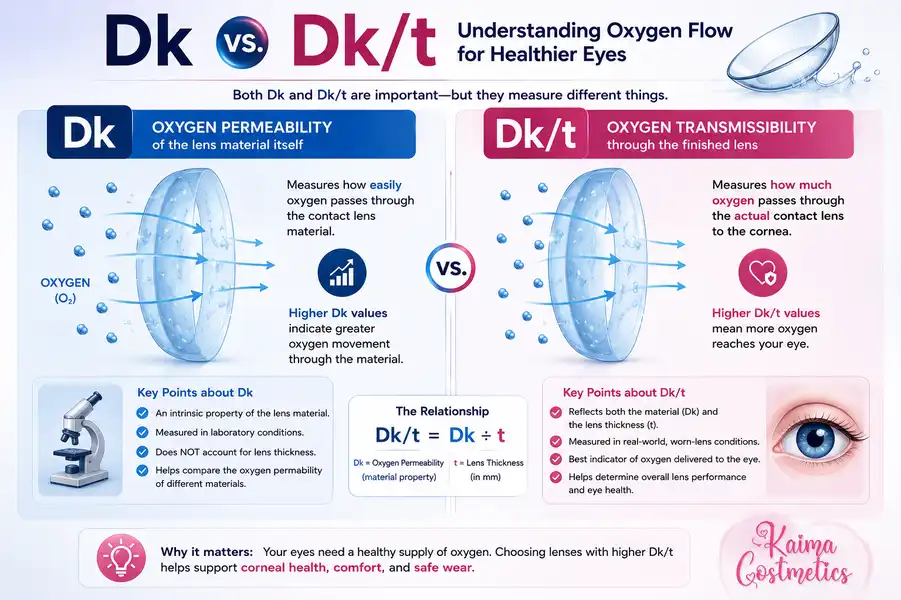
Eye care professionals commonly use two measurements.
Dk
Measures oxygen permeability of the lens material itself.
Higher Dk values indicate greater oxygen movement through the material.
Dk/t
Measures oxygen transmissibility through the finished lens.
This measurement accounts for:
- Material properties
- Lens thickness
Most clinicians consider Dk/t the more practical measurement because it reflects real-world lens performance.
Higher Dk/t values generally improve corneal oxygenation.
Corneal Hypoxia
One of the most important concepts in modern contact lens science is corneal hypoxia.
Corneal hypoxia occurs when insufficient oxygen reaches corneal tissues.
Potential consequences include:
- Redness
- Swelling
- Discomfort
- Blurred vision
- Reduced lens tolerance
- Increased infection susceptibility
Historically, hypoxia represented one of the largest limitations of contact lens wear.
Advances in lens materials have dramatically reduced this problem.
Hydrogel vs Silicone Hydrogel
Modern colored contacts are primarily manufactured using either hydrogel or silicone hydrogel materials.
Hydrogel Lenses
Hydrogel materials transmit oxygen largely through their water content.
Advantages:
- Soft feel
- Immediate comfort
- Lower cost
Limitations:
- Lower oxygen transmission
- Greater dehydration during wear
- Reduced long-term comfort for some users
Silicone Hydrogel Lenses
Silicone hydrogel materials represented one of the most significant advances in contact lens technology.
Rather than relying primarily on water content, silicone channels facilitate oxygen transport.
Advantages:
- Higher oxygen permeability
- Better corneal oxygenation
- Reduced hypoxia risk
- Improved comfort during long wear periods
Limitations:
- Higher cost
- Slightly firmer feel for some wearers
Material Comparison
| Feature | Hydrogel | Silicone Hydrogel |
| Oxygen Permeability | Moderate | High |
| Corneal Oxygenation | Lower | Higher |
| Long-Wear Comfort | Moderate | High |
| Dehydration Resistance | Moderate | Better |
| Cost | Lower | Higher |
For many eye care professionals, silicone hydrogel has become the preferred material for routine colored contact lens wear because of its superior oxygen performance.
How Professionals Evaluate Contact Lens Fit
Many consumers assume contact lenses are one-size-fits-all.
This assumption is incorrect.
Every eye has unique anatomical characteristics.
Professional lens fitting evaluates how a lens interacts with those characteristics.
Base Curve
The base curve describes lens curvature.
It must align closely with corneal shape.
An inappropriate base curve may cause:
- Excessive movement
- Tight fitting
- Reduced comfort
Diameter
Diameter influences:
- Lens coverage
- Stability
- Appearance
Diameter selection becomes particularly important with colored contacts because it affects both fit and cosmetic outcome.
Lens Centration
Professionals evaluate whether the lens remains centered over the cornea.
Poor centration may cause the following:
- Visual disturbances
- Reduced comfort
- Cosmetic irregularities
Lens Movement
Healthy lenses should move slightly during blinking.
Too little movement may reduce tear exchange.
Too much movement may increase friction.
Tear Film Evaluation
Professionals also assess:
- Tear quantity
- Tear quality
- Dry eye risk
- Ocular surface health
This step is often overlooked by consumers but plays a major role in lens success.
What Eye Care Professionals Consider A Successful Lens
Patients often judge success by appearance.
Clinicians evaluate several additional criteria.
A successful colored contact lens should provide:
- Healthy corneal physiology
- Adequate oxygen transmission
- Stable tear film interaction
- Proper centration
- Appropriate movement
- Consistent visual quality
- Long-term comfort
A lens that creates a beautiful color transformation but compromises corneal health would not be considered clinically successful.
Modern contact lens science increasingly emphasizes balancing aesthetics, comfort, and ocular physiology.
The best colored contact lens is not necessarily the lens that changes eye color most dramatically.
It is the lens that provides the safest long-term outcome while achieving the wearer’s cosmetic goals.
Are Colored Contacts Safe?
Yes. Colored contacts are generally safe when prescribed, fitted, and worn according to professional guidelines.
The color itself is not the risk.
The risk comes from:
- Poorly manufactured lenses
- Improper fitting
- Inadequate hygiene
- Excessive wear
- Unregulated sellers
This is why organizations such as the U.S. Food and Drug Administration, the American Academy of Ophthalmology, the American Optometric Association, and Centers for Disease Control and Prevention consistently emphasize proper contact lens fitting and care.
Why Colored Contacts Are Regulated Medical Devices
Many consumers are surprised to learn that cosmetic colored contacts are regulated medical devices.
The reason is simple.
Every contact lens sits directly on living tissue and can influence:
- Corneal health
- Tear film stability
- Oxygen delivery
- Infection risk
The FDA regulates colored contacts to help ensure the following:
- Material safety
- Manufacturing quality
- Biocompatibility
- Performance standards
Unregulated lenses often bypass these safeguards.
The Biggest Risks of Improper Colored Contact Use
The overwhelming majority of serious contact lens complications are preventable.
Most occur when wearers:
- Sleep in lenses unnecessarily
- Share lenses
- Ignore replacement schedules
- Purchase lenses from unlicensed sellers
- Use improper cleaning methods
Corneal Abrasions
A corneal abrasion is a scratch on the cornea.
Poorly fitted lenses may create excessive friction during blinking.
Symptoms include:
- Pain
- Tearing
- Light sensitivity
- Blurred vision
- Foreign-body sensation
Even minor abrasions can create entry points for microorganisms.
Microbial Keratitis
One of the most serious contact lens complications is Microbial Keratitis.
Microbial keratitis occurs when microorganisms infect corneal tissue.
Common pathogens include:
- Pseudomonas aeruginosa
- Staphylococcus species
- Fungal organisms
Without prompt treatment, microbial keratitis may cause permanent vision damage.
Acanthamoeba Keratitis
Among the most feared contact lens infections is Acanthamoeba keratitis.
Although uncommon, this infection can be devastating.
Acanthamoeba organisms are frequently found in:
- Tap water
- Lakes
- Hot tubs
- Swimming pools
This is one reason eye care professionals strongly advise against exposing contact lenses to water.
A simple rule exists:
Never rinse contact lenses with tap water.
Corneal Ulcers
A corneal ulcer is an open sore on the cornea.
Ulcers often develop when infections penetrate deeper corneal layers.
Symptoms may include:
- Severe pain
- Redness
- Blurred vision
- Eye discharge
- White spots on the cornea
Corneal ulcers are considered ophthalmic emergencies.
Delayed treatment may result in permanent vision loss.
Inflammation
Inflammation is the body’s response to irritation or injury.
Improper contact lens wear may trigger inflammatory responses involving:
- Immune cells
- Cytokines
- Tear-film disruption
Persistent inflammation can reduce comfort and damage ocular tissues over time.
Vision Loss
Permanent vision loss from colored contacts is rare.
However, it has occurred in cases involving:
- Untreated infections
- Advanced corneal ulcers
- Severe corneal scarring
Most of these complications are preventable through professional fitting and proper hygiene.
Warning Signs You Should Never Ignore
Healthy contact lens wear should be comfortable.
Persistent symptoms usually indicate a problem.
Remove lenses and seek professional evaluation if you experience:
- Persistent redness
- Eye pain
- Excessive tearing
- Blurred vision
- Light sensitivity
- Eye discharge
- Foreign-body sensation
One of the most dangerous mistakes wearers make is continuing lens wear after symptoms develop.
Early intervention often prevents serious complications.
Daily vs Monthly vs Yearly Colored Contacts
Replacement schedules influence both safety and convenience.
A lens designed for one day should never be used for one month.
Daily Disposable Colored Contacts
Daily lenses are worn once and discarded.
Advantages:
- Lowest maintenance requirements
- Reduced contamination risk
- Ideal for beginners
- Excellent for occasional wear
Best for:
- First-time users
- Travelers
- Makeup artists
- Event wear
Monthly Colored Contacts
Monthly lenses are cleaned and stored after each use.
Advantages:
- Lower long-term cost
- Wider product selection
- Suitable for frequent wear
Best for:
- Regular users
- Budget-conscious consumers
Yearly Colored Contacts
Yearly lenses are designed for extended replacement schedules.
Advantages:
- Less frequent replacement
Limitations:
- Greater deposit accumulation
- Higher maintenance demands
- Greater dependence on hygiene
Many eye care professionals increasingly favor daily or monthly replacement schedules because fresher lenses generally support better ocular health.
How Much Do Colored Contacts Cost?
Costs vary depending on:
- Brand
- Material
- Replacement schedule
- Prescription requirements
Typical market ranges include:
| Lens Type | Typical Cost Range |
| Daily Disposable | Higher per lens, lower maintenance |
| Monthly | Moderate |
| Prescription Colored Lenses | Moderate to high |
| Specialty Costume Lenses | Moderate to high |
Consumers should view colored contacts as medical devices rather than cosmetic accessories.
A low purchase price is rarely a reliable indicator of quality.
How To Choose Colored Contacts Like An Eye Care Professional
Many consumers start with color.
Professionals start with eye health.
Step 1: Evaluate Eye Health
Assess:
- Corneal health
- Tear-film stability
- Dry-eye risk
- Vision needs
Step 2: Identify Natural Eye Color
Light eyes:
- Enhancement tints
- Opaque tints
Dark eyes:
- Opaque tints
Step 3: Determine Wearing Frequency
Occasional use:
- Daily disposables
Frequent use:
- Monthly lenses
Step 4: Select Material
Prioritize:
- Oxygen transmissibility
- Comfort
- Lifestyle requirements
Many professionals prefer silicone hydrogel materials for routine wear.
Step 5: Evaluate Manufacturer Reputation
Choose manufacturers with:
- Regulatory oversight
- Established safety records
- Proven material technologies
Step 6: Match Cosmetic Goals
Natural appearance:
- Multi-tone pigmentation
- Soft limbal rings
- Enhancement tints
Dramatic appearance:
- Opaque pigments
- Strong limbal rings
- Larger diameters
This framework closely mirrors how eye care professionals evaluate lens suitability.
How To Care For Colored Contacts
Proper hygiene remains one of the most effective ways to prevent complications.
Cleaning
Use only approved contact lens solutions.
Never use:
- Tap water
- Saliva
- Household cleaners
Storage
Store lenses in a clean case using fresh solution.
Replace lens cases regularly.
Handling
Always:
- Wash hands
- Dry hands thoroughly
- Inspect lenses before insertion
Replacement
Follow manufacturer replacement schedules exactly.
Extending wear beyond recommended intervals increases risk of:
- Deposits
- Irritation
- Infection
Frequently Asked Questions
Can Colored Contacts Change Brown Eyes?
Yes.
Opaque lenses can transform brown eyes into:
- Blue
- Gray
- Green
- Hazel
- Honey
Results depend on pigment density and lens design.
Do Colored Contacts Affect Vision?
Properly fitted lenses should not significantly affect vision.
Some users may occasionally notice:
- Halos
- Reduced contrast sensitivity
- Increased awareness of lens patterns in low light
Can I sleep in colored contacts?
Generally, no.
Unless specifically approved for overnight wear, colored contacts should be removed before sleeping.
Sleeping in lenses increases
- Infection risk
- Hypoxia risk
- Inflammatory complications
Are Colored Contacts Safe For Teenagers?
Many teenagers can wear colored contacts safely.
Success depends primarily on:
- Maturity
- Hygiene compliance
- Professional supervision
What Color Contacts Look Most Natural?
The most realistic lenses typically include the following:
- Hazel tones
- Honey tones
- Gray tones
- Olive-green tones
Natural-looking lenses usually feature the following:
- Multi-tone pigmentation
- Iris detailing
- Subtle limbal rings
Key Takeaways
Colored contacts are medical devices designed to alter eye appearance while optionally correcting vision.
The best colored contacts balance:
- Appearance
- Comfort
- Oxygen transmission
- Proper fit
- Long-term eye health
Natural-looking results depend on more than color alone. Iris pattern design, limbal rings, pigment layering, diameter, and lighting conditions all influence appearance.
Silicone hydrogel materials generally provide superior oxygen transmission compared with traditional hydrogel materials.
Professional fitting remains one of the most important factors affecting safety, comfort, and cosmetic outcomes.
Consumers should purchase lenses only from reputable manufacturers and retailers that follow recognized medical standards.
Final Thoughts
The best colored contacts are not necessarily the lenses that create the most dramatic transformation.
They are the lenses that preserve ocular health while achieving the wearer’s cosmetic goals.
A successful colored contact experience depends on three factors:
- Safe materials
- Proper fit
- Responsible lens care
Eye color can be changed in seconds.
Protecting corneal health requires consistent attention every day.
When selected carefully, fitted professionally, and maintained correctly, colored contacts can provide a safe, comfortable, and realistic way to enhance or transform eye appearance without compromising long-term vision.