Red contact lenses occupy a unique position within the colored contact lens market because they are rarely chosen to replicate natural eye color.
Most colored contact lenses attempt to mimic naturally occurring iris shades such as blue, green, hazel, or gray.
Red lenses serve a different purpose.
They are designed to create visual contrast, character transformation, and dramatic aesthetic effects that would not occur naturally in human eyes.
This explains why red contact lenses are disproportionately used in cosplay, theatrical productions, horror films, fantasy photography, Halloween costumes, and character-driven visual storytelling.
The lens is not functioning as an enhancement tool. It is functioning as a visual identity tool.
Why Red Contact Lenses Became Associated With Horror, Fantasy, and Supernatural Characters
The popularity of red contact lenses is partly driven by visual psychology.
According to the Association of Psychological Science, “Redness in and around the eyes can be perceived as a cue of irritation, illness, or abnormality, while the color red more broadly is often associated with anger, aggression, and dominance.”
Filmmakers and character designers have used this association for decades.
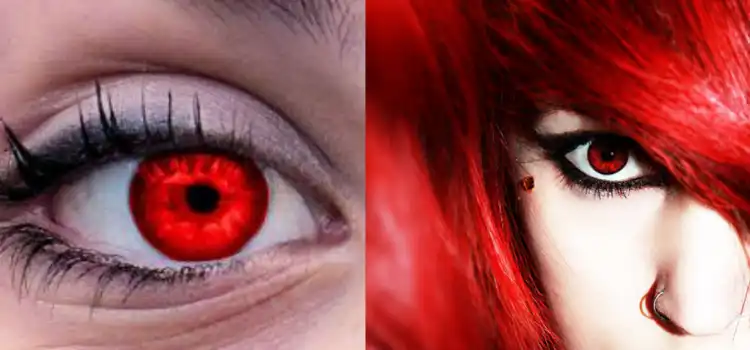
Characters portrayed as vampires, demons, possessed individuals, monsters, or supernatural beings frequently receive red-eye visual effects because the color immediately signals that the character exists outside normal human experience.
Contact lens manufacturers responded to this demand by developing increasingly specialized theatrical lens designs, including full-red iris patterns, mesh lenses, blind-effect lenses, and scleral lenses that extend beyond the iris.
As a result, red contact lenses evolved from simple colored lenses into a specialized category of theatrical eye prosthetics used throughout entertainment, cosplay, and costume industries.
Why Red Contact Lenses Look Different on Dark and Light Eyes
The final appearance of a red contact lens depends on the interaction between lens pigmentation and natural iris pigmentation.
The iris is not a uniform color.
Brown eyes contain higher concentrations of melanin, which absorbs and scatters incoming light differently than blue or green eyes.
Because of this, enhancement-tint red lenses often appear subtle on dark brown eyes.
The underlying iris pigment remains partially visible through the lens design.
Opaque red lenses solve this problem by incorporating denser pigment layers that block more of the natural iris color.
This is why contact lens manufacturers typically recommend opaque red lenses for individuals with dark eyes who want a vivid transformation.
The principle is similar to painting over a dark wall.
A translucent coating changes the hue slightly. An opaque coating creates a more complete color replacement.
How Entertainment Industries Shaped the Development of Red Contact Lenses
Red contact lenses did not become popular because consumers wanted a different eye color.
Their growth was largely driven by entertainment.
Throughout the twentieth century, filmmakers, costume designers, special-effects artists, and character illustrators searched for ways to make non-human characters appear visually distinct.
The eyes became one of the most powerful tools.
Audiences can recognize changes in eye appearance almost instantly.
A subtle change in iris color can transform a character from ordinary to supernatural.
As vampire films, fantasy franchises, anime productions, gaming culture, and comic-book adaptations expanded globally, demand increased for contact lenses capable of creating dramatic visual transformations.
Manufacturers responded by developing increasingly specialized pigment technologies.
Early colored lenses focused primarily on cosmetic enhancement.
Later generations focused on character creation.
This shift helped create entirely new categories of products:
- Vampire lenses
- Demon lenses
- Blind-effect lenses
- Mesh lenses
- Scleral theatrical lenses
- Anime-inspired lenses
Modern red contact lenses therefore represent more than a cosmetic accessory.
They are the result of decades of interaction between eye-care technology and entertainment design.
Why Manufacturing Red Contact Lenses Is More Difficult Than Most People Realize
Creating a red contact lens involves more than adding red dye to a lens material.
The manufacturing process must satisfy several competing requirements simultaneously.
The lens must:
- Produce a visible red appearance
- Maintain optical clarity
- Preserve oxygen transmission
- Remain comfortable during wear
- Avoid direct pigment contact with ocular tissues
Modern colored contact lenses typically encapsulate pigment layers within the lens matrix rather than placing pigment directly on the surface.
This approach reduces the likelihood of pigment-related irritation while preserving lens performance.
Engineers must also consider how red pigments interact with ambient lighting.
A lens that appears vivid outdoors may appear darker indoors.
A lens that looks bright under studio lighting may appear dramatically different in natural daylight.
This is one reason manufacturers frequently produce multiple shades of red, including:
- Scarlet
- Crimson
- Maroon
- Ruby
- Blood red
Each pigment profile creates a different visual outcome depending on iris color, lighting conditions, and lens opacity.
The challenge is not simply producing a red lens.
The challenge is producing a predictable red appearance under diverse real-world conditions.
How Different Users Evaluate Red Contact Lenses
Not everyone shopping for red contact lenses is solving the same problem.
A makeup artist, cosplayer, filmmaker, and contact lens wearer may all purchase red lenses for entirely different reasons.
This distinction influences lens selection.
A cosplay enthusiast often prioritizes character accuracy.
The goal is visual authenticity.
Lens opacity, iris design, and pattern detail become important.
A film production team evaluates different criteria.
The lens must remain visible under studio lighting and camera exposure settings.
Subtle pigmentation that works in person may disappear on screen.
Fashion users often seek a balance between wearability and uniqueness.
Their goal may be enhancement rather than complete transformation.
Halloween users typically prioritize visual impact.
Comfort remains important, but dramatic appearance often becomes the primary consideration.
Understanding the intended use case frequently helps narrow lens choices more effectively than comparing colors alone.
The best lens is not necessarily the most dramatic lens. It is the lens that best supports the wearer’s objective.
Why Red Contact Lenses Create Stronger Visual Impact Than Most Colored Lenses
Red is one of the least common colors associated with healthy human irises.
As a result, the human visual system immediately recognizes red eyes as unusual.
Visual perception research demonstrates that humans rapidly detect colors associated with biological significance.
Red is often linked to:
- Blood
- Danger
- Warning signals
- Emotional intensity
- Aggression
These associations influence how observers interpret facial appearance.
A blue or green lens may appear attractive or natural.
A red lens often appears dramatic, mysterious, intimidating, supernatural, or otherworldly.
This psychological effect explains why red contact lenses have become strongly associated with horror, fantasy, and supernatural storytelling.
The lens changes more than eye color.
It changes how the observer interprets the entire face.
Why Eye Care Professionals Evaluate Cosmetic Lenses Differently Than Consumers
Consumers often evaluate red contact lenses according to appearance.
Eye care professionals evaluate them according to physiology.
The difference is significant.
A consumer may focus on:
- Color intensity
- Character accuracy
- Costume compatibility
- Visual impact
A practitioner focuses on:
- Corneal oxygenation
- Lens fit
- Tear film stability
- Wearing schedule
- Ocular health risk
Both perspectives matter.
The challenge is that the most visually dramatic lens is not always the healthiest lens for prolonged wear.
A highly opaque lens design may create a striking transformation.
That same design may require careful engineering to maintain oxygen delivery and comfort.
This is why professional fitting remains important even for purely cosmetic lenses.
The goal is not simply achieving the desired appearance.
The goal is achieving that appearance without compromising ocular health.
Why Oxygen Transmission Matters in Red Contact Lenses
The cornea is unique among human tissues.
It contains no blood vessels.
Instead, much of its oxygen is obtained directly from the surrounding atmosphere.
When a contact lens covers the cornea, oxygen must pass through the lens material before reaching the ocular surface.
This requirement creates a fundamental engineering challenge.
The lens must simultaneously:
- Change eye appearance
- Maintain optical clarity
- Preserve comfort
- Deliver oxygen
Colored contact lenses introduce additional complexity because pigment layers become part of the lens design.
Modern manufacturing techniques generally encapsulate pigments within the lens matrix to minimize disruption of oxygen flow.
Even so, lens material remains critically important.
Hydrogel and silicone hydrogel materials differ substantially in oxygen permeability.
This explains why practitioners often evaluate more than color alone when recommending cosmetic lenses.
The healthiest lens is not necessarily the brightest lens.
It is the lens that balances visual transformation with physiological performance.
Why Red Contact Lenses Are Available in Different Replacement Schedules
A daily disposable red contact lens and a 90-day reusable red contact lens may appear similar.
Their intended use is very different.
Replacement schedules evolved to solve specific challenges associated with contact lens wear.
Daily disposable lenses reduce maintenance requirements.
A fresh lens is used each day.
This eliminates concerns related to:
- Lens storage
- Cleaning compliance
- Protein deposits
- Solution contamination
Reusable lenses provide a different advantage.
They reduce replacement frequency and may be more practical for users who wear red contact lenses repeatedly for cosplay, performance, or recurring events.
The choice is often less about appearance and more about behavior.
A person attending a single Halloween event may benefit from a daily disposable lens.
A performer using the same character throughout a season may prefer a reusable option.
Understanding how often the lens will be worn often helps determine the most appropriate replacement schedule.
The Relationship Between Iris Pigmentation and Red Contact Lens Performance
Not all eyes respond to colored contact lenses in the same way.
The reason lies in iris pigmentation.
Brown eyes contain higher concentrations of melanin.
Melanin absorbs light and influences how colors are perceived through the iris.
When a lightly tinted red lens is placed over a dark brown iris, the natural pigmentation remains visually dominant.
The result may appear muted or darker than expected.
Opaque red lenses address this challenge by increasing pigment density.
These lenses create a stronger barrier between the natural iris color and incoming light.
This allows the red coloration to remain visible even on very dark eyes.
The interaction resembles placing colored glass over a bright light versus a dark surface.
The background influences the final visual outcome.
Understanding this relationship helps explain why two people wearing the same red contact lens may achieve dramatically different results.
Why Red Contact Lenses Became a Global Product Category
The earliest colored contact lenses were largely developed to enhance or alter natural eye appearance.
Blue, green, hazel, and gray lenses attempted to replicate colors already found in human populations.
Red contact lenses emerged from a different commercial demand.
Consumers were not trying to look natural.
They were trying to look extraordinary.
The growth of horror films, fantasy franchises, cosplay communities, gaming culture, anime conventions, social media content creation, and special-effects makeup created demand for eye colors that do not naturally exist.
Manufacturers recognized an opportunity.
Instead of designing lenses that mimicked biology, they began designing lenses that supported storytelling.
This shifted colored contact lenses into a new category sometimes described as theatrical or costume lenses.
Red became one of the most commercially successful colors because it immediately communicates transformation.
A blue lens may change appearance.
A red lens changes character.
This distinction helps explain why red contact lenses remain one of the most recognizable specialty lens categories worldwide.
How Red Contact Lenses Reflect the Evolution of Colored Contact Lens Technology
The development of red contact lenses mirrors the broader evolution of colored contact lenses.
Early colored lenses faced several limitations.
Manufacturers struggled with:
- Pigment consistency
- Comfort
- Oxygen transmission
- Lens thickness
- Natural appearance
Advances in lens manufacturing gradually solved many of these challenges.
Improved pigment encapsulation techniques allowed designers to create more vivid colors while reducing direct interaction between pigments and ocular tissues.
Advances in hydrogel and silicone hydrogel materials improved comfort and oxygen delivery.
Digital manufacturing technologies increased precision.
These developments allowed manufacturers to produce increasingly complex designs, including:
- Multi-ring patterns
- Limbal ring effects
- Character lenses
- Anime-inspired designs
- Full-red iris lenses
- Scleral costume lenses
The modern red contact lens is therefore not a simple cosmetic accessory.
It is the result of decades of progress in biomaterials science, optics, manufacturing, and medical-device engineering.
Why Red Contact Lenses Became a Focus of Eye Safety Campaigns
Few contact lens categories receive as much safety attention as theatrical lenses.
The reason is not the color itself.
The reason is user behavior.
Many consumers purchase red lenses for:
- Halloween
- Costume parties
- Festivals
- Cosplay events
These buyers are often occasional lens wearers rather than regular contact lens users.
Research and public health campaigns have repeatedly shown that occasional wearers may be less familiar with:
- Lens hygiene
- Wearing schedules
- Storage requirements
- Infection risks
This created a challenge for eye care professionals.
A lens intended for a single event could still create complications if worn improperly.
Organizations such as eye-care associations and regulatory agencies increasingly emphasized that cosmetic lenses should be treated as medical devices rather than fashion accessories.
The message remains important today.
The safety profile of a red contact lens depends far more on manufacturing quality, fitting accuracy, and wear habits than on the color itself.
The Future of Red Contact Lens Technology
The next generation of red contact lenses is likely to be influenced by trends already reshaping the broader contact lens industry.
Manufacturers continue investing in:
- Higher oxygen transmission
- Improved surface wettability
- Advanced pigment technologies
- Customized lens geometries
- Digital manufacturing systems
At the same time, developments in smart contact lens research may eventually introduce lenses capable of functions beyond appearance alone.
Researchers are investigating contact lenses that may support:
- Health monitoring
- Drug delivery
- Augmented visual information
- Physiological sensing
Whether these technologies become mainstream remains uncertain.
What is clear is that colored contact lenses will continue benefiting from innovations originally developed for medical and vision-correction applications.
Historically, many advances in comfort and safety appeared first in clinical lenses before influencing cosmetic lens design.
The same pattern is likely to continue.
Understanding What Red Contact Lenses Really Represent
Most people see red contact lenses as a cosmetic product.
That description is accurate but incomplete.
Red contact lenses sit at the intersection of multiple disciplines:
- Eye care
- Optics
- Biomaterials science
- Manufacturing engineering
- Visual psychology
- Entertainment design
- Fashion culture
A single lens combines decades of research into corneal physiology, oxygen permeability, polymer chemistry, pigment technology, and visual perception.
The consumer may see a dramatic red eye effect.
Behind that effect exists a complex system of scientific and industrial innovation.
Understanding that broader context changes how red contact lenses are viewed.
They are not simply colored lenses.
They are examples of how medical-device technology evolved beyond vision correction to support identity, storytelling, performance, creativity, and self-expression.
That evolution explains why red contact lenses remain one of the most distinctive categories in the global contact lens market.